
Explore the inner critic in autistic and ADHD minds, and discover how self-compassion can transform self-talk, wellbeing and resilience.
Autistic and ADHD people are often told they are “too hard on themselves” or that they “overthink everything.” Beneath this can lie a persistent inner critic shaped by neurodivergence, lived experience and years of misunderstanding or masking. It can affect self-worth, contribute to burnout and make it harder to seek support.
Research suggests that autistic and ADHD people tend to experience higher levels of self-criticism and lower self-compassion than allistic peers. But here’s what often gets missed: this harsh inner voice is not a feature of being neurodivergent. It is learned, developing over time through repeated correction, not being believed, and a persistent mismatch between neurodivergent ways of being and the environments around us.
Overview
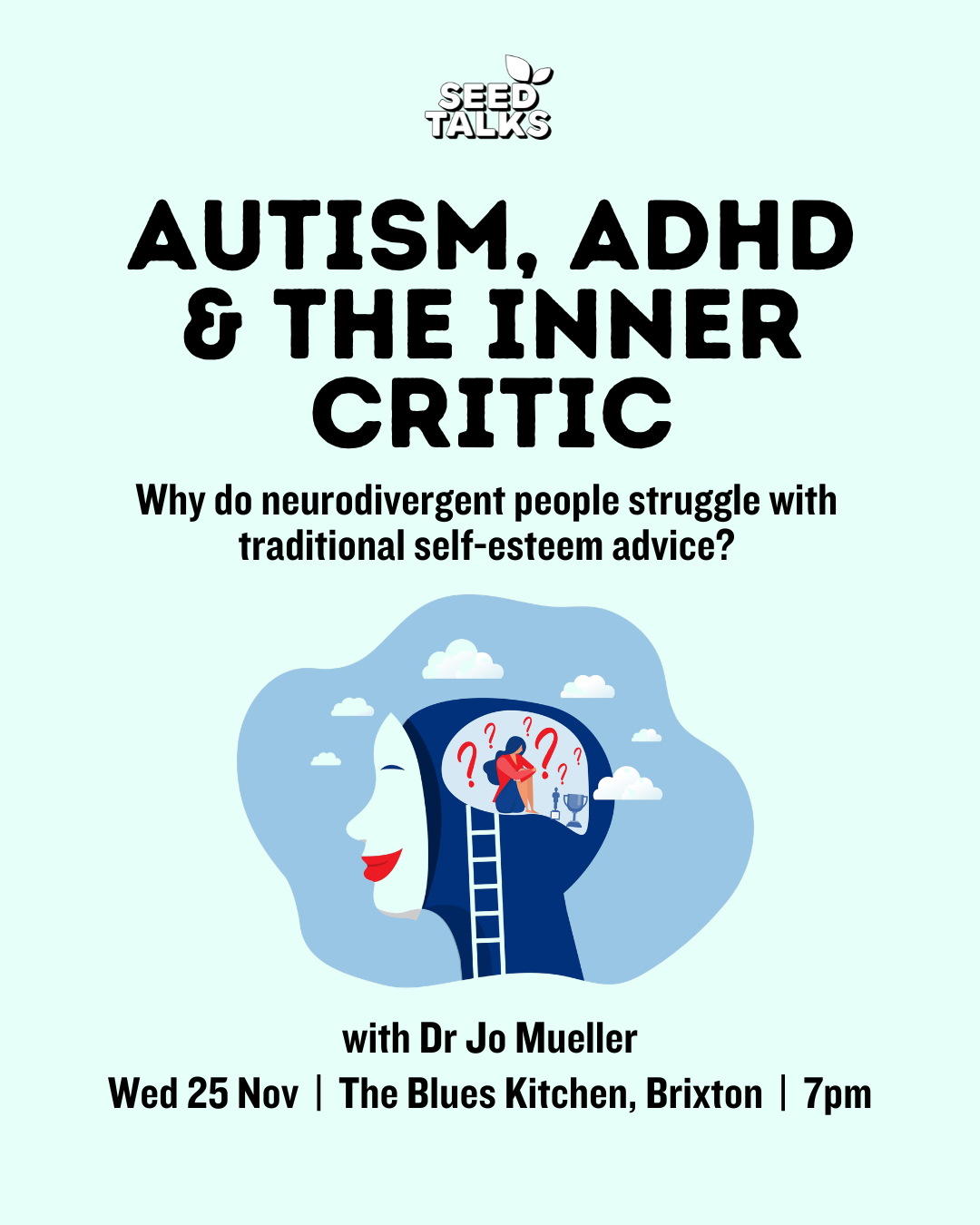
In this live in-person session for Seed Talks, Dr Jo Mueller offers a compassionate, evidence-based exploration of where this voice comes from for autistic and ADHD folk, how it shapes everyday life, and how self-compassion can help.
Drawing on clinical practice, research into neurodivergent women’s experiences of self-criticism, and the real voices of autistic and ADHD people, Jo will explain why standard “just think positive” advice so often falls short, and what can genuinely make a difference instead. You’ll gain a clearer understanding of your internal world and begin building a kinder relationship with yourself.
What you’ll learn
Where the inner critic comes from: How bottom-up processing, the double empathy problem, late or missed diagnosis and a lifetime of being corrected can shape self-talk in autistic and ADHD people.
How it shows up in daily life: The links between the inner critic and people-pleasing, rejection sensitivity, perfectionism, masking and burnout, and why these patterns often begin as attempts to protect us.
Why self-compassion works: An accessible introduction to the threat, drive and soothing systems, the difference between tender and fierce self-compassion, and why self-compassion is not about letting yourself off the hook.
Practical, neuroaffirming strategies: Gentle tools to try at your own pace, including connecting with your “wise self”, the “no wonder, because…” approach and kindsight.
Event details
Date: Wednesday 25 November 2026
Time: Doors open at 7pm, and the talk starts at 7:30pm. The evening finishes at 9:30pm. Come down early to grab a good seat!
Venue: The Blues Kitchen Brixton, 40 Acre Lane, London SW2 5SP or online livestream
Format: In person - livestream tickets also available
Refunds: Available up to 7 days before the event
Follow: @seedtalks on Instagram
Who should attend
Individuals: Anyone who is autistic, ADHD, AuDHD or otherwise neurodivergent, whether diagnosed, self-identifying or just wondering, who recognises a loud inner critic.
Parents & loved ones: Parents, partners, family members and friends who want to understand this experience, and parents hoping to model self-compassion for their children.
Professionals: Therapists, healthcare providers, educators, coaches and HR professionals looking to understand the inner critic through a neuroaffirmative lens and support neurodivergent clients and colleagues more effectively.
Your workshop facilitator:
Dr Jo Mueller: A clinical psychologist with 20 years’ experience and co-founder of The Neurodiversity Practice. Jo specialises in supporting autistic and ADHD adults and families, and has supervised doctoral research exploring self-criticism in neurodivergent women. She is also the author of a forthcoming parenting book for neurodivergent families.
REPLAY INCLUDED: If you can’t make the date, a recording will be available for anyone purchasing a ticket.
Previous webinar attendees said:
“I have found this incredibly helpful. We are quite new to this space and I am so grateful - thank you.”
“Really enjoyed this webinar and the presenting style. Good balance of making it accessible and deeper diving. Excellent.”
“Thank you so much for this evening, we are new to exploring this area and have found this evening really insightful.”
“Very informative and no pressure, made to feel comfortable from the start and just refreshing to feel seen and understood.”
“You have helped us to feel validated, seen and heard, and able to move through our daughter’s recent diagnosis. Thank you.”
“Just found it very useful and practical, not only informative.”
“I really liked the helpful suggestions of different ways of explaining… I struggle to connect with abstract concepts so that was really helpful. thank you!”
“Thank you so much for the seminar, really clear and useful.”
“Another really insightful webinar with so many helpful take-aways, really well & kindly explained.”
“I really appreciated the webinar, the content was great and there were regular check ins of the comments and encouragement of emojis/participation; I felt that participants were valued and heard.”
“Thank you very much indeed, really helpful and reassuring (not alone!).”
Please note that this webinar is for educational and informational purposes and is not clinical advice or therapy.
The Neurodivergent Parent Space
Our online event will also give you a taster of what we offer in The Neurodivergent Parent Space, our unique community of parents who are neurodivergent (or wondering).
In a warm, neuroaffirmative space, we offer a library of tailored,evidence-based resources, our premium self-paced emotional regulation course, tea & chat sessions with experienced clinical psychologists, and much more.
Plus, of course, connection with other neurodivergent parents to help you thrive on your parenting journey.
The community is FREE to try - and thereafter just £24.99 per month, which is the cost of one of our monthly in-house webinar (Seed Talks events not included).
Find out more - and come and join us here!
-
The webinar will be held over Zoom. You will receive a link to the webinar before it starts
-
No, at The Neurodiversity Practice, we understand that you can participate with your camera off. You may wish to type and offer your thoughts and contributions in the chat.
-
Yes if you cannot access the training live it will be recorded and you will have access to the recording for one month.
-
YES! We have diagnosed and self identifying facilitators, lived experience through family members as well as clinical experience as psychologists. We also have a panel of neurodivergent parents who co-produce with us and support the work we do.